
F-Grade vs P-Grade Silicon Carbide: The Standard Behind the Label
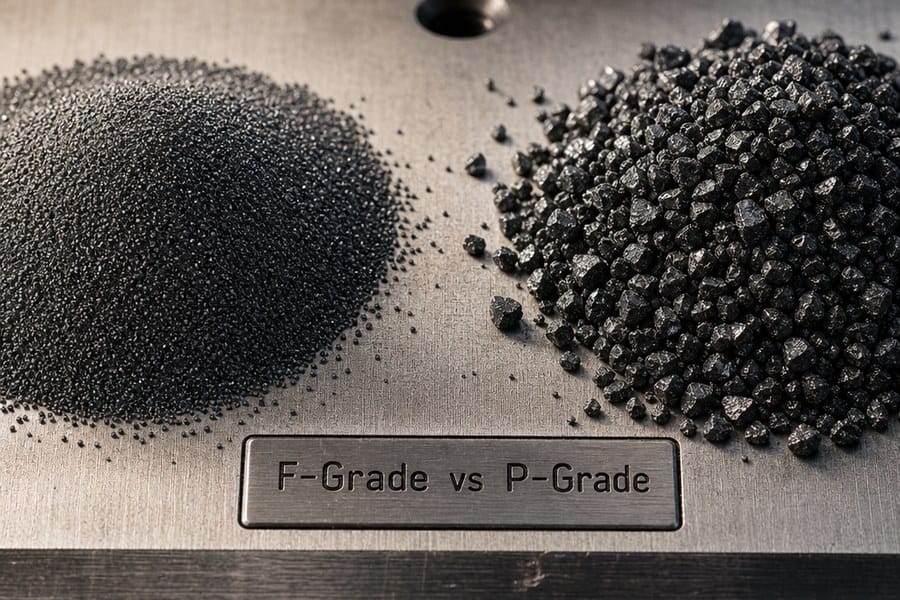
Specifying silicon carbide by grit number alone is a common — and expensive — mistake. An F80 and a P80 carry the same nominal size, yet their allowable particle distributions diverge enough that substituting one for the other can produce surface finishes outside tolerance, accelerate wheel wear beyond budget, or trigger coating adhesion failures on the first inspection. Understanding the FEPA grading framework that defines both scales is not procedural housekeeping; it directly determines whether a process runs within specification or not.
The FEPA Framework: Two Standards, One Numerical System
Der Federation of European Producers of Abrasives (FEPA) administers two parallel grading standards for abrasive grains. The F-series (FEPA 42-1:2006) governs bonded and loose abrasive applications — grinding wheels, lapping compounds, blasting media. The P-series (FEPA 43-1:2006) was developed specifically for coated abrasives — sandpaper, sanding belts, and abrasive discs. Both are internationally adopted, but they are not interchangeable despite sharing the same numerical scale from P12/F12 to P2500/F1200.
The critical difference lies in the statistical distribution model each standard applies to the grain population. F-grade uses a relatively wide distribution with defined median diameter and allowable coarse fractions. P-grade applies a tighter, more symmetrical distribution centered on a median diameter that is deliberately smaller than the equivalent F-grade number — because in coated abrasives, a single oversize particle scratches a surface that hundreds of correctly sized grains are meant to finish.
Particle Size Distributions: Where the Real Divergence Lives
Each standard specifies grain size through a set of sieve tests and, for finer grits, sedimentation or laser diffraction analysis. The table below compares the specified median diameters and allowable coarse-fraction limits for selected grit sizes across both scales.
| Grit Designation | FEPA Scale | Median Diameter (µm) | Max Coarse Fraction (%) |
|---|---|---|---|
| 60 | F60 | 265 | 3% above 355 µm |
| 60 | P60 | 269 | 0.5% above 400 µm (tighter tail) |
| 120 | F120 | 116 | 3% above 150 µm |
| 120 | P120 | 127 | 0.5% above 150 µm |
| 320 | F320 | 29.2 | 3% above 40 µm |
| 320 | P320 | 36.0 | 0.5% above 53 µm |
At coarser grits the medians are similar, but the coarse-fraction tolerance in the F-series is six times more permissive than in the P-series. As grit number rises above 100, the median diameters also begin to diverge measurably — P320 is actually coarser in median diameter than F320. Sourcing the wrong grade for high-grit finishing processes is a statistically predictable source of scratch defects.
Application Mapping: Matching the Grade to the Process
Selecting the correct series requires understanding how grain distribution interacts with each process mechanism. For abrasive purchasing decisions, reviewing what to look for when sourcing silicon carbide provides a useful pre-qualification checklist alongside the grading criteria discussed here.
- Gebundene Schleifmittel (Schleifscheiben, honing sticks): F-grade is the correct specification. The vitrified or resin bond matrix accommodates the wider distribution, and the coarser tails contribute to open wheel structure and chip clearance.
- Schleifmittel auf Unterlage (belts, sheets, discs): P-grade is mandatory. Electrostatic grain orientation during manufacturing requires a tighter size distribution to achieve consistent cutting-edge density per unit area.
- Loose abrasive lapping and polishing: F-grade through F600; for sub-micron surface finishes below Ra 0.05 µm, manufacturers typically specify by actual D50 and D99 values rather than relying solely on FEPA grade.
- Blasting and surface preparation: F-grade grit from F12 to F46 is standard; profile depth is predictable because the coarse fraction in each lot falls within the defined sieve limits.
- Metallographic sample preparation: P-grade exclusively, as scratch-free surfaces are required and a single oversize particle invalidates the sample.
Black vs Green Silicon Carbide: Does Grade Interact with Crystal Type?
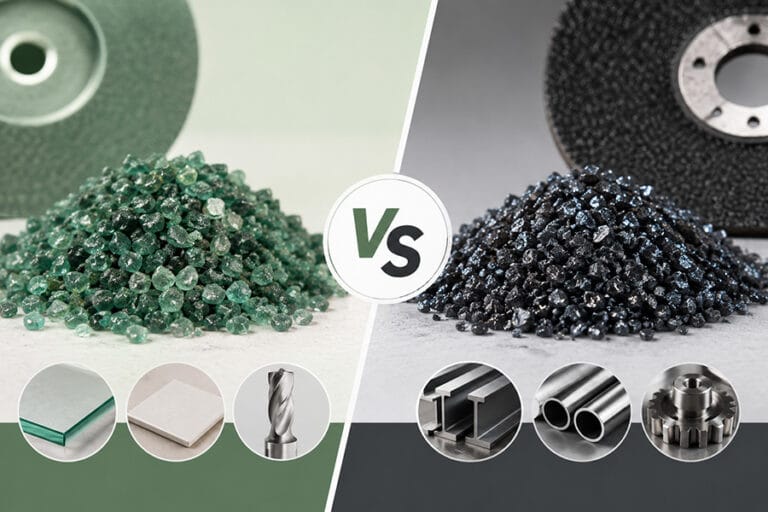
Both black silicon carbide (98–99% SiC purity) Und green silicon carbide (99%+ purity) are produced and graded to FEPA F and P standards. The grading standard is independent of crystal chemistry — it governs particle size distribution only, not hardness, friability, or purity. Green SiC’s higher purity and sharper friability make it preferred for precision grinding of cemented carbide and ceramics, while black SiC dominates cast iron, non-ferrous metals, and non-metallics. Regardless of color, the same F-vs-P selection logic applies.
For processes that demand the extreme hardness and chemical inertness characteristic of advanced SiC chemistries, it is worth noting that beta-phase material occupies a distinct segment — covered in detail in this overview of beta silicon carbide applications and advantages. Alpha-phase black and green SiC dominate conventional abrasive grading.
Procurement Implications: Verifying Grade Compliance at the Source
A certificate of conformance stating “FEPA F80” or “FEPA P80” should be backed by particle size analysis data. Reputable suppliers provide laser diffraction reports (ISO 13320) or sieve analysis reports that confirm D10, D50, and D99 values against the relevant FEPA table. When evaluating suppliers, request lot-specific data — not just a generic grade specification — and verify that the measurement method is declared.
Pricing structures also reflect the tighter tolerances of P-grade production. The additional classification steps required to achieve a 0.5% coarse-fraction limit add cost relative to F-grade material at equivalent grit. Buyers comparing quotes across grades should ensure they are comparing the same standard — a recurring source of landed-cost surprises. For current market context, Die silicon carbide price landscape in China provides useful benchmarking data, and longer-term budget planning benefits from tracking the silicon carbide price trend across production cycles.
Summary: The Decision Rule in Practice
The F vs P distinction reduces to one functional question: is the grain being held in a bond matrix or applied to a flexible substrate? Bonded and loose applications use F-grade; coated applications use P-grade. Beyond that primary rule, any process where a single oversize particle causes an unacceptable defect — precision lapping, metallographic preparation, optical substrate finishing — demands P-grade or a tighter custom specification confirmed by lot-level data. Specifying by FEPA series rather than grit number alone eliminates an entire category of preventable process failures.
Frequently Asked Questions
Q: Can F-grade silicon carbide be substituted for P-grade at the same grit number?
A: Not without process risk. At grit 120, for example, F120 permits up to 3% of particles above 150 µm, while P120 limits this to 0.5%. In coated abrasive applications, those oversize particles cause scratch defects that exceed typical Ra tolerance by a factor of 2–5×. Substitution is only acceptable in rough material-removal stages where surface finish is not a critical output.
Q: Which FEPA standard covers the P-grade specification for coated abrasives?
A: FEPA 43-1:2006 governs coated abrasive grain sizing (P-grade). Bonded and loose abrasive grains are covered by FEPA 42-1:2006 (F-grade). Both standards define particle size through sieve analysis for grits up to approximately F/P220, and by sedimentation or laser diffraction for finer sizes.
Q: At what grit size do F-grade and P-grade median diameters diverge most significantly?
A: Divergence becomes practically significant above grit 150. At P320, the FEPA-specified median diameter is 36.0 µm versus 29.2 µm for F320 — a 23% difference. Above P400/F400 the gap widens further, which is why specifying only the grit number without the series prefix is inadequate for fine-finishing applications.
Q: Does the F vs P grade classification apply to both black and green silicon carbide?
A: Ja. FEPA grading standards are material-agnostic with respect to SiC chemistry. Both black SiC (≥98% purity) and green SiC (≥99% purity) are produced and sold to F-grade and P-grade specifications. The grade selection is driven by the end application, not by SiC color or purity level.
Q: What documentation should I request from a silicon carbide supplier to verify FEPA grade compliance?
A: Request a lot-specific particle size distribution report stating D10, D50, and D99 values measured by a declared method (ISO 13320 laser diffraction or FEPA sieve analysis protocol). A certificate of conformance alone is insufficient; the report must show that the D99 value falls within the FEPA coarse-fraction limit for the declared grade and grit number.
Über Henan Superior Abrasives (HSA)
Henan Superior Abrasives (HSA) is a China-based global supplier of high-performance abrasive and advanced ceramic materials for industrial applications worldwide. Our core product range includes black silicon carbide, green silicon carbide, electronic grade silicon carbide (SiC), white fused alumina, brown fused alumina, Bor Carbide, fused calcium aluminates, and SG abrasives.
Serving customers in 30+ countries, HSA supplies reliable materials for abrasives, refractories, technical ceramics, semiconductor applications, precision polishing, sandblasting, metallurgy, and high-performance construction materials.
Get a Quote or Free Sample
Looking for a reliable supplier of premium abrasive and advanced ceramic materials? Contact our technical team today — we respond within 24 hours and can arrange free samples for qualified projects.
- 📧 E-Mail: sales@superior-abrasives.com
- 💬 WhatsApp: +86-186-3863-8803
Vielleicht interessieren Sie sich auch für …
Kontaktieren Sie uns
Holen Sie sich kostenloses Angebot
Gegründet in 2001, HSA ist ein führender Anbieter von Kieselsäuren und Schleifeln in China, und auch die Premium-Quelle für Hochleistungsprodukte für Beton- und Schleifindustrien.