
Groen versus zwart siliciumcarbide: Belangrijkste verschillen & Hoe te kiezen
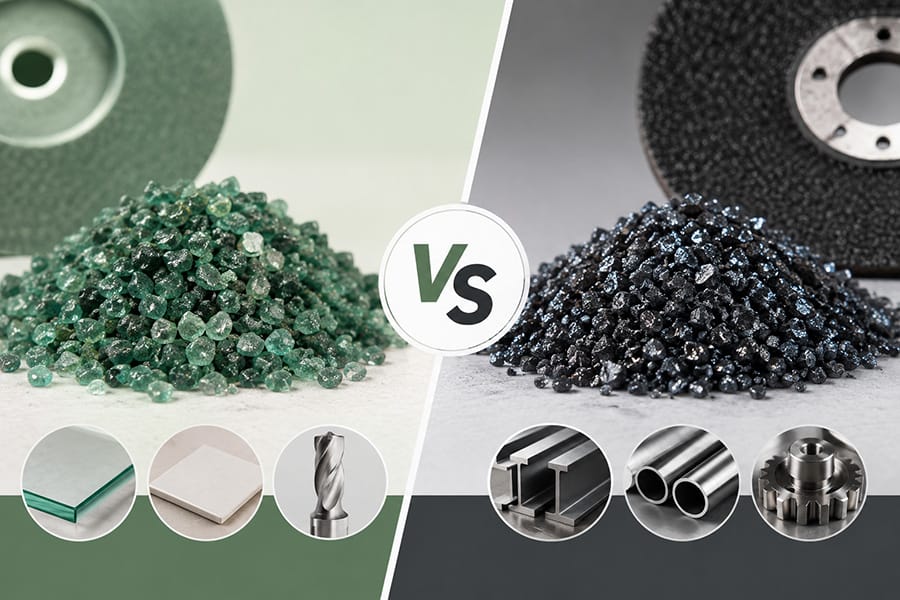
Silicon carbide (SiC) is one of the hardest and most versatile abrasive materials in the world. But when engineers, procurement teams, and technical buyers search for silicon carbide, they quickly encounter a fork in the road: groen siliciumcarbide or black silicon carbide?
At first glance, the difference seems cosmetic. In practice, the choice between these two grades directly affects grinding precision, tool life, cost efficiency, and final product quality. This guide breaks down everything you need to know — properties, applications, performance trade-offs, and a clear decision framework — so you can choose with confidence.
What Is Silicon Carbide?
Silicon carbide is a synthetically produced compound of silicon and carbon (SiC), manufactured through the Acheson process — a high-temperature fusion of silica sand and petroleum coke in an electric resistance furnace. The result is a crystalline material with exceptional hardness (9.0–9.5 on the Mohs scale), high thermal conductivity, low thermal expansion, and outstanding chemical resistance.
The color of the final product — green or black — is determined by raw material purity, furnace temperature, and the position of the material within the furnace. These seemingly minor manufacturing variables create two products with meaningfully different properties.
Groene siliciumcarbide: Properties & Strengths
Green silicon carbide (GC) is produced from higher-purity raw materials under tighter furnace conditions. The resulting material has a characteristic light-to-medium green color and a purity of 99%+ SiC.
Key Properties
- SiC Purity: ≥ 99%
- Mohs-hardheid: ~9.4
- Kristalstructuur: α-SiC (hexagonal), highly ordered
- Fracture Behavior: More brittle — produces sharp, fresh cutting edges upon fracture
- Thermische geleidbaarheid: High (~120 W/m·K)
- Kleur: Light green to medium green
Primary Applications
Green SiC’s higher purity and sharper crystal fracture make it the preferred choice for precision and high-performance grinding:
- Grinding cemented carbides (tungsten carbide tools, inserts)
- Processing titanium alloys and high-nickel superalloys
- Lapping and polishing optical glass and precision ceramics
- Semiconductor wafer slicing and surface finishing
- Cutting tools for non-ferrous metals and advanced composites
Zwarte siliciumcarbide: Properties & Strengths
Black silicon carbide (BC) is the more widely produced variety, with a purity of 95–98% SiC and a characteristic dark gray to black color. The slightly lower purity comes from naturally occurring trace amounts of free carbon and iron silicide, which actually contribute to its toughness.
Key Properties
- SiC Purity: 95%–98%
- Mohs-hardheid: ~9.1–9.2
- Kristalstructuur: α-SiC with some β-SiC, slightly less ordered
- Fracture Behavior: Tougher — retains grain shape longer under pressure
- Thermische geleidbaarheid: Good (~80–100 W/m·K)
- Kleur: Dark gray to black
Primary Applications
Black SiC’s toughness and cost-effectiveness make it the dominant choice for heavy-duty and general-purpose applications:
- Grinding cast iron, gray iron, and malleable iron
- Processing non-ferrous metals: copper, aluminium, brass, bronze
- Cutting natural and engineered stone, concrete, and masonry
- Blasting and surface preparation (shot blasting, zandstralen)
- Lapping softer metals and rubber components
- Refractory materials and kiln furniture production
- Wire sawing for photovoltaic silicon ingots
Groen versus zwart siliciumcarbide: Side-by-Side Comparison
| Eigendom | Green SiC (GC) | Black SiC (BC) |
|---|---|---|
| SiC Purity | ≥ 99% | 95%–98% |
| Mohs-hardheid | ~9.4 | ~9.1–9.2 |
| Toughness | Lower (more brittle) | Higher |
| Cutting Sharpness | ⭐⭐⭐⭐⭐ | ⭐⭐⭐⭐ |
| Best For | Precision, hard materials | Heavy-duty, general use |
| Typical Materials Ground | Carbides, ceramics, glas, titanium | Ijzer, stone, rubber, non-ferrous metals |
| Relative Cost | Higher | Lower |
| Production Volume | Smaller | Larger |
Hoe te kiezen: A Practical Decision Guide
The right choice between green and black SiC comes down to three factors: the material you are processing, the precision required, En your cost constraints.
Choose Green Silicon Carbide When:
- You are grinding cemented carbides, technische keramiek, or hard ferrous alloys where extreme sharpness is required
- Your application demands tight tolerances and fine surface finishes (Ra ≤ 0.4 µm)
- You are working with brittle materials where fracture risk requires the cleanest possible cut
- The material cost of your workpiece is high and tool marks or sub-surface damage are unacceptable
- You are producing precision optical components, semiconductors, or high-end cutting tools
Choose Black Silicon Carbide When:
- You are processing cast iron, non-ferrous metals, stone, or rubber
- Your application is volume-intensive and cost-per-ton matters more than ultimate precision
- You need abrasive grain that retains its shape under load — e.g., bonded abrasive wheels for aggressive stock removal
- You are producing refractory bricks, blasting media, or wire saw slurry
- The project requires large quantities where a small price differential has significant budget impact
When Both Could Work:
For applications like lapping non-ferrous metals, fine-grinding aluminum oxide ceramics, or producing coated abrasives for multi-purpose use, both grades can deliver acceptable results. In these cases, the tie-breaker is typically cost: black SiC at equivalent grit size will be more economical with only marginal performance difference.
Veelgestelde vragen
Is green silicon carbide always better than black?
Not necessarily. Green SiC is harder and purer, but “better” depends entirely on the application. For grinding hard carbides or optical glass, green SiC is the superior choice. For grinding cast iron or masonry, black SiC’s toughness makes it more efficient and cost-effective. Choosing the wrong grade wastes money or reduces performance — there is no universal “better.”
Can green and black SiC be used interchangeably?
In some mid-range applications (coated abrasives, general lapping), they can be substituted, but performance will differ. In high-precision or high-hardness applications, substituting black SiC for green SiC typically results in faster wheel wear, inferior surface finish, and reduced dimensional accuracy.
What grit sizes are available for each type?
Both green and black SiC are available across a wide grit range — typically F8 to F1200 (macro grits) and D series micro grits down to sub-micron powders. Standard international specifications include FEPA (European), ANSI (US), HIJ (Japan), and GB/T (China). Always specify the grit standard when ordering to ensure consistency.
What is the price difference between green and black SiC?
Green silicon carbide typically carries a 20–40% price premium over black SiC of equivalent grit size, reflecting the higher raw material purity and more demanding production controls. The exact differential varies by grit, quantity, and market conditions. For large-volume purchases, this difference can be significant — making grade selection a meaningful cost lever.
Is silicon carbide safe to handle?
Silicon carbide in bulk or granular form is generally safe when handled with appropriate PPE (gloves, dust mask or respirator, safety glasses). Fine SiC powders pose an inhalation risk and should be handled under controlled conditions. SiC is chemically inert and not classified as a carcinogen, but fine crystalline dusts of any kind should be treated with caution per local occupational health standards.
How should I specify silicon carbide in a purchase order?
A complete silicon carbide specification should include: grade (green or black), SiC-zuiverheid (%), grit size and standard (e.g., F60 FEPA), bulk density, moisture content limit, and any application-specific chemistry requirements (e.g., free carbon content, iron content). Voor kritische toepassingen, request a Certificate of Analysis (CoA) with every shipment.
Over Henan Superior Schuurmiddelen (HSA)
Henan Superior Abrasives Import & Export Co., Ltd. (HSA) is one of China’s leading suppliers of industrial abrasive and refractory raw materials, headquartered in Zhengzhou, Henan Province. With over two decades of export experience, HSA supplies green silicon carbide, black silicon carbide, fused alumina, boorcarbide, and silica fume to customers across 30+ countries in North America, Europa, the Middle East, and Asia-Pacific.
All products are available in a full range of FEPA, ANSI, HIJ, and GB/T grit sizes, with minimum order quantities starting at one 20-foot container (~20 metric tons). HSA provides CoA documentation, flexible packaging, and full export documentation support for every shipment.
Ready to Source Green or Black Silicon Carbide?
Tell us your application, required grit size, and target quantity — we’ll provide a tailored product recommendation and competitive quote within 24 hours.
📧 E -mail: sales@superior-abrasives.com
💬 Whatsapp: +86-186-3863-8803
Mogelijk bent u ook geïnteresseerd in…

Neem contact met ons op
Krijg gratis offerte
Opgericht in 2001, HSA is een toonaangevende leverancier van siliciumdoem en schuurmiddelen in China, en ook de premium bron van krachtige producten voor beton- en schuurmiddelenindustrie.