
How Grit Size Affects Surface Finish: A Practical Guide for SiC Abrasive Users
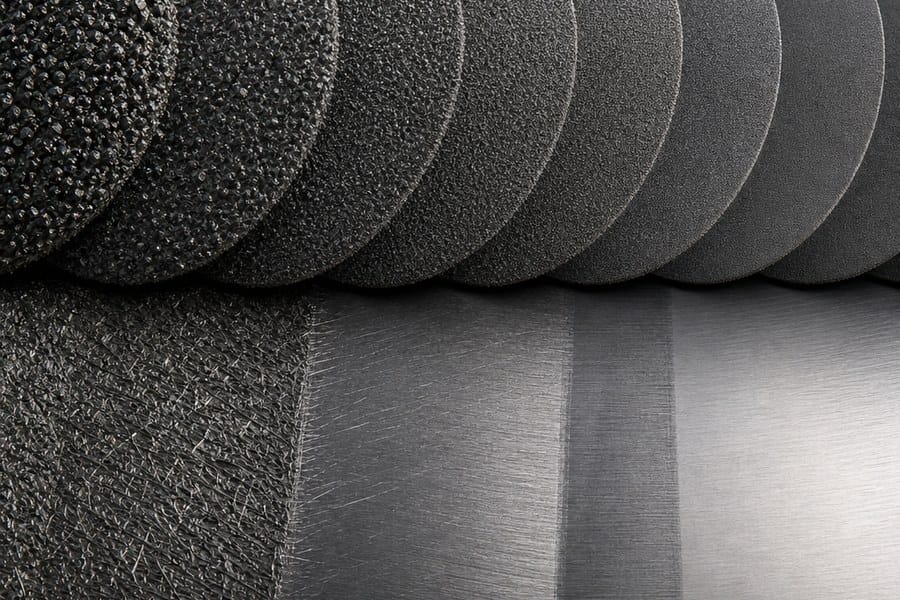
Specifying the wrong grit size for a silicon carbide abrasive operation doesn’t just produce a poor cosmetic result — it can push a component outside its dimensional tolerance, trigger fatigue crack initiation at a rough surface, or force a costly rework cycle that erases the margin on a production run. Understanding the precise relationship between grit size and achievable surface roughness (Ra) is therefore not a finishing detail; it is a core process engineering decision.
The Physics Behind Grit Size and Material Removal
Every abrasive grain acts as a single-point cutting tool. As grit number decreases — meaning individual particles grow larger — the depth of cut per grain increases, and each pass removes more material. This produces deeper, wider scratches on the workpiece surface, directly raising the Ra value. І навпаки, fine grits (higher FEPA numbers) engage the surface with smaller indentation depths, generating shallower scratch patterns and lower Ra.
Silicon carbide is particularly sensitive to this relationship because of its conchoidal fracture mode. SiC grains fracture to expose fresh, sharp edges during use, sustaining a consistent cutting geometry longer than many oxide abrasives. That self-sharpening behaviour means the Ra prediction from a given grit size remains stable across a longer portion of the wheel or paper’s life — but it also means that a single-step grit jump can produce a measurable surface quality shift that softer abrasives might mask.
Grit Size to Ra Correlation: Reference Data for SiC Operations
The table below provides typical achievable Ra ranges for green and black silicon carbide abrasives operating on common engineering substrates under controlled conditions. Values assume fresh abrasive, correct bond hardness, and appropriate cutting fluid or coolant. Actual Ra will shift with wheel wear, workpiece hardness, and traverse rate.
| FEPA Grit (P-scale) | Approximate Particle Size (µm) | Typical Ra Range — Metals (µm) | Typical Ra Range — Ceramics / Stone (µm) |
|---|---|---|---|
| P36 – P60 | 425 – 269 | 3.2 – 6.3 | 4.0 – 8.0 |
| P80 – P120 | 201 – 125 | 1.6 – 3.2 | 2.0 – 4.0 |
| P180 – P320 | 82 – 46 | 0.8 – 1.6 | 0.8 – 2.0 |
| P400 – P600 | 35 – 26 | 0.4 – 0.8 | 0.4 – 0.8 |
| P800 – P1200 | 22 – 15 | 0.1 – 0.4 | 0.1 – 0.4 |
| P2000 – P2500 | 10 – 8 | 0.025 – 0.1 | 0.025 – 0.1 |
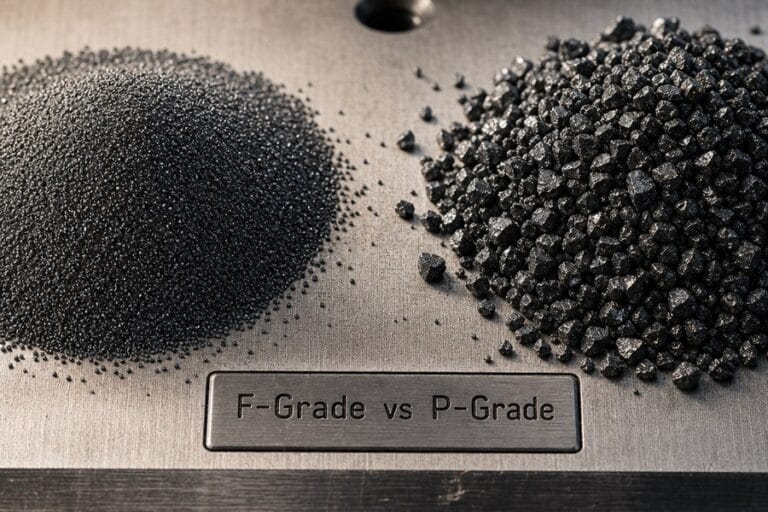
Note that FEPA P-scale and ANSI/CAMI scales diverge above P220. When sourcing abrasive products internationally, always confirm which standard applies — a nominal “220 grit” product differs by roughly 15 µm in median particle size between the two systems, which is enough to shift Ra by a measurable increment on precision surfaces. For guidance on evaluating supplier quality documentation, see Silicon Carbide: Where to Buy and What to Look For.
Selecting the Right Starting Grit: A Stage-Based Approach
Reaching a target Ra in a single abrasive step is rarely practical or economical. Multi-stage sequences reduce total cycle time by removing bulk stock efficiently with coarse grits and then erasing damage layers progressively with finer ones. Each step should remove approximately 1.5–2× the scratch depth left by the previous grit before advancing.
- Stock removal stage (P36–P80): Prioritise material removal rate (MRR). Acceptable for structural components where final finish is achieved in later steps. Surface damage layer at this stage may extend 20–50 µm subsurface.
- Intermediate conditioning (P120–P320): Reduces subsurface damage and brings Ra into the 0.8–3.2 µm band required for most functional engineering surfaces. Critical for components subject to cyclic loading.
- Fine finishing (P400–P1200): Targets sealing faces, bearing journals, and optical or semiconductor substrates. Ra below 0.4 µm becomes achievable; coolant management and workpiece fixturing rigidity are dominant variables at this stage.
- Superfinishing / lapping (P1200 and finer): Used for precision optical elements, wafer substrates, and advanced ceramic components. At this scale, abrasive concentration and carrier fluid viscosity govern the outcome more than nominal grit size alone.
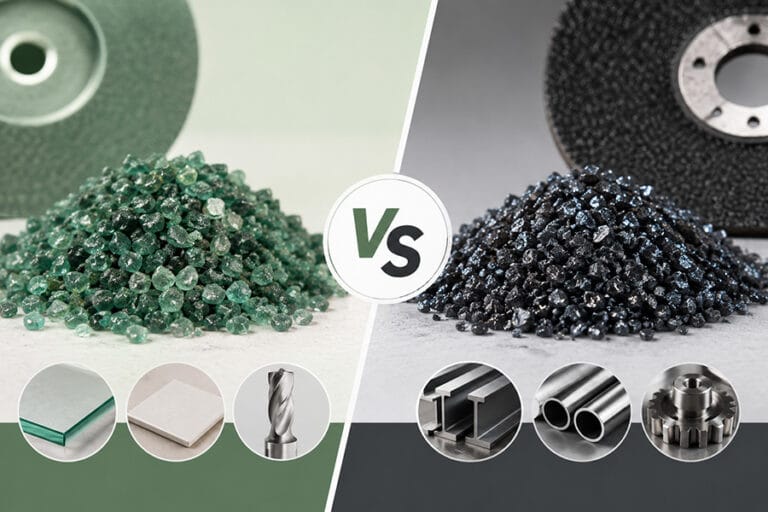
Green silicon carbide is preferred for hard, brittle materials — cemented carbide, technical ceramics, and glass — because its higher purity and sharper crystalline morphology reduce sub-surface fracture at each stage transition. Black SiC serves well on cast iron, non-ferrous metals, and rubber where its slightly tougher grain holds up under higher contact pressures.
How Workpiece Material Hardness Shifts the Grit–Ra Relationship
A grit size that delivers Ra 0.8 µm on grey cast iron (≈200 HB) will produce a noticeably rougher surface on hardened tool steel (60–65 HRC) under identical process conditions. Harder materials resist grain penetration, which means each grain ploughs a narrower but often more irregular groove and leaves higher peak-to-valley variation. To compensate, move one or two grit steps finer than you would for a softer alloy at the same Ra target.
For hard ceramics and refractory materials, brittle fracture at grain boundaries dominates material removal rather than plastic deformation. This produces a rougher surface per unit of grit size compared to ductile metals. Reducing grit size, slowing traverse speed, and increasing coolant flow all suppress the lateral cracking that drives Ra upward in these materials. Understanding how SiC behaves in high-hardness applications — including its role in structural and advanced material contexts — is covered in detail in the overview of Бета -кремнію Карбід (β-SIC) Заявки та переваги.
Process Variables That Modify Grit Performance
Grit size is the primary lever, but several secondary variables can shift the achievable Ra by half a grade or more in either direction:
- Wheel or belt speed: Higher surface speed generally reduces Ra for a given grit by decreasing chip load per grain. Проте, excessive speed on SiC wheels can cause glazing, which paradoxically raises Ra as dull grains drag rather than cut.
- Workpiece feed rate: Slower traverse reduces Ra. For each doubling of feed rate, expect Ra to increase by roughly 25–40% on metallic substrates.
- Bond hardness (for bonded abrasives): A harder bond retains grains longer, useful for soft workpieces. On hard materials, a softer bond allows worn grains to shed and expose fresh cutting edges, maintaining Ra consistency.
- Coolant type and delivery: Flood coolant reduces thermal damage and grain loading. Dry grinding with SiC on steel can raise Ra by 0.2–0.5 µm versus wet conditions at the same grit due to thermal expansion of the workpiece and resinous loading of the wheel face.
- Abrasive grain uniformity: Tight particle size distribution, as specified under ISO 8486 for bonded abrasives or ISO 6344 for coated abrasives, reduces Ra scatter across a production batch. Inconsistent grit sizing — a common issue with lower-grade SiC — introduces outlier deep scratches that elevate Rmax and Rz even when mean Ra appears acceptable.
Common Specification Mistakes and How to Avoid Them
One recurring error is selecting grit size based on surface appearance rather than measured Ra. Visual assessment is unreliable below Ra 1.6 µm; two surfaces with visually identical sheen can differ by 0.4 µm Ra — enough to cause a sealing failure or a tribological performance gap. Always verify with profilometry, specifying both Ra and Rz to capture peak height anomalies that Ra alone misses.
Another frequent mistake is skipping grit stages to save time. Jumping from P80 directly to P400 forces the fine abrasive to remove deep P80 scratches, dramatically increasing cycle time and wearing the fine-grit abrasive prematurely. A correctly sequenced P80 → P180 → P400 progression is faster in total than the two-step shortcut in most production scenarios. When evaluating new SiC abrasive sources — particularly for export supply — checking lot-to-lot particle size consistency should be a standard qualification step, as described in the Silicon Carbide sourcing guide.
Frequently Asked Questions
Q: What grit size of SiC abrasive should I use to achieve Ra 0.8 µm on hardened steel?
A: For hardened steel (58–65 HRC), Ra 0.8 µm typically requires a P320–P400 silicon carbide abrasive under wet conditions. On softer steels (under 40 HRC), P180–P220 may suffice. Always verify with a profilometer rather than visual inspection, and confirm the abrasive meets ISO 8486 particle size distribution tolerances to avoid outlier deep scratches that elevate Rz above spec.
Q: What is the difference between green SiC and black SiC for surface finishing?
A: Green SiC has a purity of ≥99% SiC and a harder, more friable crystal structure (Mohs ~9.4), making it preferable for grinding cemented carbide, advanced ceramics, and glass where clean, sharp cutting with minimal subsurface damage is required. Black SiC contains ~98–98.5% SiC with a tougher grain that withstands higher contact pressures, making it better suited for cast iron, non-ferrous metals, and rubber. For a given grit size, green SiC typically achieves a slightly lower Ra on brittle hard materials due to sharper grain geometry.
Q: How many grit stages should I use to go from a machined surface (Ra 3.2 µm) to a fine finish (Ra 0.2 µm)?
A: A minimum of four stages is recommended: P120 (Ra ~1.6 µm), P320 (Ra ~0.8 µm), P800 (Ra ~0.4 µm), and P1500–P2000 (Ra ~0.1–0.2 µm). Each stage should remove material until scratch marks from the previous grit are fully eliminated before advancing. Skipping stages increases total cycle time and fine-abrasive consumption disproportionately — in controlled tests, a two-step skip (P120 to P600) increases P600 dwell time by 3–5× compared to the correctly staged sequence.
Q: Does FEPA grit size correspond directly to ANSI/CAMI grit size?
A: FEPA P-scale and ANSI/CAMI scales are equivalent up to approximately P220/220. Above that point they diverge: FEPA P320 corresponds to a median particle size of ~46 µm, while ANSI 320 is approximately 32 µm — a difference of ~14 µm that can shift Ra by 0.2–0.3 µm on precision surfaces. Always request a particle size distribution certificate from your supplier and confirm which standard (ISO 6344 for coated, ISO 8486 for bonded) the product is manufactured to.
Q: Can I use the same SiC grit progression for both metal grinding and ceramic lapping?
A: No. Ceramics remove primarily by brittle fracture rather than plastic deformation, so the Ra produced per grit size is higher than on ductile metals — typically by 0.5–1.5× at equivalent grit. For technical ceramics like alumina or silicon nitride, start one or two grit steps finer than you would for steel at the same target Ra, reduce traverse speed by 20–30%, and increase coolant flow to suppress lateral cracking. Lapping compounds for ceramics also typically use a fluid carrier to control grit distribution uniformity, which is distinct from the dry or flood-cooled wheel grinding used for metals.
Про Henan Superior Abrasives (HSA)
Абразиви Henan Superior (HSA) is a China-based global supplier of high-performance abrasive and advanced ceramic materials for industrial applications worldwide. Our core product range includes black silicon carbide, green silicon carbide, electronic grade silicon carbide (SiC), white fused alumina, brown fused alumina, карбід бору, fused calcium aluminates, and SG abrasives.
Serving customers in 30+ countries, HSA supplies reliable materials for abrasives, refractories, technical ceramics, semiconductor applications, precision polishing, sandblasting, metallurgy, and high-performance construction materials.
Get a Quote or Free Sample
Looking for a reliable supplier of premium abrasive and advanced ceramic materials? Contact our technical team today — we respond within 24 hours and can arrange free samples for qualified projects.
- 📧 Електронна пошта: sales@superior-abrasives.com
- 💬 WhatsApp: +86-186-3863-8803
Вас також може зацікавити…
Зв’яжіться з нами
Отримайте безкоштовну цитату
Заснований у 2001, HSA - провідний постачальник кремнезему та абразивів у Китаї, а також преміум-джерело високоефективних продуктів для бетонних та абразивних галузей.