SiC 纯度证书实际上告诉您什么——以及它没有告诉您什么
供应商发送分析证书显示 98.5% 碳化硅纯度, 采购团队批准订单. 六周后, 耐火衬里过早失效, 或者烧结部件的翘曲超出公差范围. 证书并没有错,只是不完整. 准确理解哪些分析方法产生这些数字, 以及他们未测量哪些导致失败的变量, 是任何材料工程师都可以应用的最具成本效益的质量控制之一.
纯度数据是如何生成的——以及该方法为何重要
商业证书上的大多数 SiC 纯度值来自三种分析途径之一: X射线荧光 (X射线荧光光谱), 湿化学滴定, 或燃烧红外检测. 每个报告不同的物理现实. XRF 通过质量分数测量元素成分,非常适合检测铁等金属杂质, 铝, 钙, 和浓度低至数十 ppm 的钛. 然而, XRF 无法区分元素碳, 二氧化硅, 和碳化硅本身——它看到硅和碳原子, 不是它们形成的阶段.
燃烧红外 (CIR) 分析燃烧样品并量化总碳. 当减去SiC相时, 残差代表 游离碳 含量——可以说是高温和电子应用中操作最关键的杂质. 仅列出的证书 “碳化硅≥98.5%” 没有具体说明方法或单独报告游离碳会留下重大的分析空白. 始终询问测试遵循哪个标准: 国际标准化组织 21068, ASTM C863, or a supplier-specific internal protocol produce results that are not directly interchangeable.
What a Purity Certificate Typically Reports
| 范围 | Typical Reporting Range | Analytical Method | Operational Relevance |
|---|---|---|---|
| SiC content (%) | 97.0–99.8% | X射线荧光光谱 + calculation | Baseline phase purity; insufficient alone |
| Free carbon (Cfree) | 0.05–0.5% | Combustion IR (国际标准化组织 21068-2) | Critical for sintering density and electrical resistivity |
| Silicon dioxide (二氧化硅) | 0.1–1.5% | Wet chemistry / X射线荧光光谱 | Lowers refractoriness; affects surface oxidation rate |
| Iron (铁) | 50–500 ppm | X射线荧光光谱 / ICP-OES | Catalyst for high-temp grain growth; semiconductor killer |
| Aluminum (铝) | 20–300 ppm | X射线荧光光谱 / ICP-OES | Affects electrical conductivity in electronic-grade SiC |
Note that particle size distribution, 多型比 (3C vs. 6H vs. 4H), and surface oxide layer thickness do not appear on any of these rows — yet each can determine whether a batch performs as specified.
The Impurities That Certificates Routinely Miss
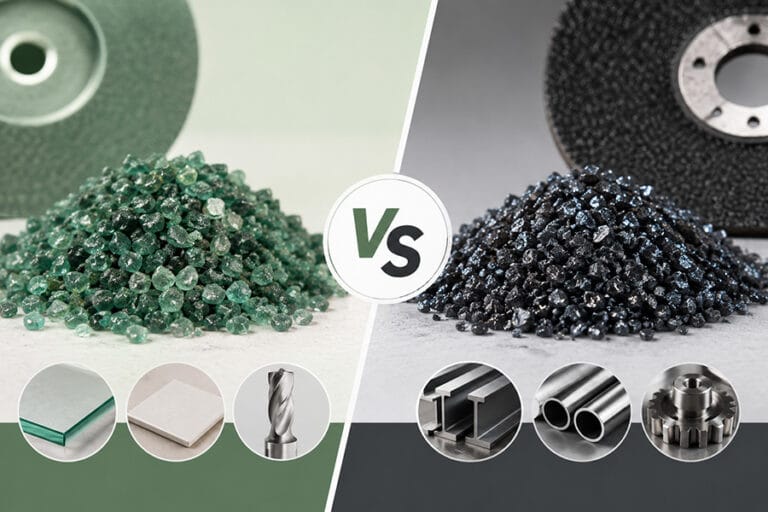
Free carbon deserves particular attention in refractory and sintering applications. Even at 0.3%, graphitic carbon inclusions create localised reducing zones inside a furnace atmosphere, accelerating refractory degradation and introducing porosity into pressure-sintered bodies. Green SiC typically carries lower free carbon than black SiC because the higher formation temperature in the Acheson process drives more complete carbide conversion. Yet certificates for both grades frequently report only total carbon, obscuring this distinction.
Polytype composition is a second invisible variable. Commercial SiC is a mixture of polytypes — primarily alpha (hexagonal 6H, 4H) and beta (cubic 3C) — with markedly different hardness, thermal conductivity, and electrical band-gap characteristics. X-ray diffraction (XRD) is the only routine method capable of quantifying polytype ratios, and it almost never appears on a standard purity certificate. For abrasive applications this may be acceptable; for power electronics substrates or precision lapping, it is not. 相似地, the specific surface area (BEA/BET method) and particle morphology — angular vs. blocky vs. platelike — directly govern material removal rates in lapping and polishing, yet they remain absent from most COAs.
For buyers sourcing advanced ceramic feedstocks — including materials like 碳化硼, which faces analogous certification gaps — the lesson is the same: request XRD data and BET surface area alongside the standard elemental panel.
Reading Between the Lines: Red Flags in Supplier Documentation
- No method citation: A certificate stating “碳化硅: 98.7%” without referencing the analytical standard cannot be verified or reproduced. Reject it or ask for the test report appendix.
- Purity reported to three decimal places from XRF alone implies false precision. XRF elemental analysis carries a typical uncertainty of ±0.1–0.3% for major constituents; three decimal places are statistically meaningless without uncertainty values.
- Absence of a free-carbon figure on any certificate destined for sintering, CVD coating, or semiconductor process environments is a material omission, not a formatting choice.
- Certificates with no lot or batch number cannot support traceability. If a failure investigation begins, untraceable material cannot be isolated or returned.
- Identical purity figures across multiple shipments without natural batch-to-batch variation (±0.1–0.2%) are a statistical anomaly and warrant independent third-party verification.
This same critical discipline applies when evaluating any advanced mineral input. Procurement teams who apply rigorous quality indicator checks before purchasing ceramic-grade materials consistently report fewer incoming inspection failures and lower total cost of ownership.
What to Request Beyond the Standard Certificate
A well-specified incoming inspection protocol for industrial SiC should require supplementary documentation beyond the COA. The following additions transform a compliance document into actionable quality data:
- ICP-OES trace metal scan reporting at minimum Fe, 铝, Ca, Ti, V, and Ni — all of which affect sintering kinetics or electrical properties at sub-100 ppm concentrations.
- XRD pattern with Rietveld refinement quantifying alpha/beta polytype ratio — essential for any application where hardness uniformity or electrical performance is specified.
- BET specific surface area (平方米/克) and D10/D50/D90 particle size distribution measured by laser diffraction in a defined dispersant medium, reported per ASTM B822 or ISO 13320.
- Free carbon content per ISO 21068-2, reported separately from total carbon.
- Moisture content at time of packing, particularly relevant for fine powders below 5 µm where surface oxidation and agglomeration accelerate during transit.
Suppliers producing electronic-grade SiC typically already maintain ICP-OES and XRD records internally; the differentiating factor is their willingness to share them as part of standard order documentation. That transparency is itself a quality signal.
Correlating Certificate Data to Real Application Performance
The most reliable validation strategy combines certificate review with application-specific acceptance testing. 用于耐火应用, a standard hot modulus of rupture (HMOR) test at service temperature — not room temperature — detects sintering anomalies and impurity-driven grain boundary weakening that XRF data cannot predict. For lapping and polishing applications, a controlled material removal rate (MRR) coupon test on a reference substrate surfaces differences in polytype distribution and particle morphology within hours.
Understanding how particle chemistry interacts with process conditions is equally important when working with other high-purity mineral systems. The same analytical rigor used to decode a SiC certificate applies when evaluating high-purity zirconium silica fume, where oxide-phase contamination similarly escapes notice on superficial COAs. Establishing an incoming quality control protocol that maps each certificate parameter to a specific failure mode — and flags the parameters that are absent — converts a passive compliance document into an active risk management tool.
When a supplier’s certificate is transparent, methodologically sound, and supplemented by third-party validation, it becomes a genuine basis for technical trust. When it is not, the certificate is a legal formality, not a quality guarantee — and the difference usually surfaces at the worst possible moment in the production cycle.
常见问题解答
问: What SiC purity level is required for semiconductor or electronic-grade applications?
一个: Electronic-grade SiC typically requires a minimum SiC content of 99.8% with total metallic impurities (铁, 铝, Ca, Ti, V, Ni) below 50 ppm combined, verified by ICP-OES rather than XRF alone. Free carbon must generally remain below 0.05% to avoid resistivity anomalies in sintered or CVD-processed components. Standard industrial-grade certificates at 98.5% are not interchangeable with this specification.
问: Which ISO or ASTM standard should govern SiC purity testing?
一个: 国际标准化组织 21068 (Parts 1–3) is the primary international standard for chemical analysis of SiC-containing refractories, covering free carbon by combustion IR, free silicon by acid dissolution, and total SiC by calculation. For abrasive grain, FEPA standard F and P series define particle size, but not chemical purity method — making explicit method citation on the COA essential. ASTM C863 covers oxidation resistance testing, not purity directly.
问: Why does free carbon content matter more than total carbon on a SiC certificate?
一个: Total carbon includes the carbon chemically bonded within the SiC lattice itself and is therefore a meaningless stand-alone figure. Free carbon — graphitic or amorphous carbon not bonded to silicon — is the operationally active impurity. At concentrations above 0.2–0.3%, free carbon creates reducing microenvironments during high-temperature processing, reduces sintered density by generating internal porosity, and increases electrical conductivity in applications requiring insulating SiC ceramics.
问: Can I use XRF data alone to verify SiC purity for a critical application?
一个: 不. XRF determines elemental mass fractions — silicon and carbon — but cannot distinguish between SiC, 二氧化硅, free Si, and free C phases. For critical applications, XRF data should be paired with combustion IR for free carbon quantification and XRD for polytype identification. ICP-OES is preferred over XRF for trace metals below 100 ppm due to its lower detection limits (typically 1–10 ppb vs. 10–100 ppm for XRF).
问: How should I handle lot-to-lot variation in SiC purity certificates from the same supplier?
一个: A statistically normal lot-to-lot variation for industrial SiC is ±0.1–0.2% in reported SiC content and ±20–30 ppm in major trace metals when production conditions are controlled. Certificates showing zero variation across 5 or more consecutive lots should trigger third-party split-sample verification. Establish acceptance limits in your purchase specification — for example, SiC ≥ 98.0%, Fe ≤ 200 ppm, free C ≤ 0.3% — and require the supplier to flag any lot falling within 10% of a limit before shipment.
关于Henan Superior Abrasives (人血清白蛋白)
河南高级磨料磨具 (人血清白蛋白) 是一家总部位于中国的全球工业应用高性能磨料和先进陶瓷材料供应商. 我们的核心产品范围包括黑碳化硅, 绿碳化硅, 电子级碳化硅 (碳化硅), 白刚玉, 棕刚玉, 碳化硼, 电熔铝酸钙, 和 SG 磨料.
服务客户于 30+ 国家, HSA 提供可靠的磨料材料, 耐火材料, 技术陶瓷, 半导体应用, 精密抛光, 喷砂, 冶金, 和高性能建筑材料.
获取报价或免费样品
寻找优质磨料和先进陶瓷材料的可靠供应商? 立即联系我们的技术团队——我们会在 24 小时并可为合格的项目安排免费样品.
- 📧 电子邮件: sales@superior-abrasives.com
- 💬 WhatsApp: +86-186-3863-8803